Current Blog
Why Trading Agents Need Context
A strategy cannot improve if its goals, tests, positions, and outcomes disappear after every run.

Most AI trading workflows answer a question and stop. They can summarize a market, draft a thesis, or suggest a test, but the next session often begins without the assumptions, constraints, and results that shaped the first one. That break is more than an inconvenience. It prevents a strategy from becoming an ongoing body of work.
The problem with starting over
A trading decision is rarely a single prompt followed by a single response. It is a chain of choices: define the objective, narrow the instruments, state the risk limits, gather evidence, test rules, monitor conditions, and decide whether an action is permitted. If each step is handled as an isolated exchange, the agent must repeatedly reconstruct the chain from fragments.
Reconstruction introduces drift. A constraint can be omitted, an old hypothesis can return after it was rejected, or a test can be repeated without recognizing that its assumptions changed. The result may look productive because new text is generated, yet the workflow is not accumulating knowledge. It is producing a sequence of disconnected answers.
What strategy context includes
Useful context is not a transcript of everything the agent has seen. It is the inspectable state of the strategy: the information required to understand what the workflow is trying to do, what it may do, what it has already tried, and what happened next.
Goals that define the strategy’s intended behavior and evaluation criteria.
Constraints such as instruments, time horizons, permissions, and risk limits.
Research sources, market observations, and the hypotheses derived from them.
Tests, configurations, paper positions, and monitoring conditions.
Outcomes, including fills, rejected actions, failures, and follow-up questions.
These elements belong together because each changes how the others should be interpreted. A backtest without its configuration is difficult to reproduce. A position without the thesis that created it is hard to evaluate. A result without the constraint that shaped execution can lead to the wrong conclusion.
Why outcomes need to remain attached
An outcome is not merely a number at the end of a run. It is evidence about a specific strategy under specific conditions. The same result can mean different things depending on the objective, time window, data, permissions, and execution path. Keeping that context attached makes the result usable rather than decorative.
Failures matter for the same reason. A rejected order may show that a guardrail worked as intended. A missing data source may explain why a test was incomplete. A paper position that never triggered may reveal that a rule was too restrictive. When these events remain connected to the strategy, the next iteration can respond to them directly.
A strategy can only learn from history if the history remains attached to the strategy.
From memory to iteration
Context changes the role of an agent from answering isolated questions to supporting iteration. The next run can begin with the previous objective, assumptions, tests, and open issues already available. It can compare a revised rule with the rule it replaces, explain why a parameter changed, and distinguish a new market condition from a repeated mistake.
This does not require the agent to treat every prior result as correct. History should be evidence, not authority. Old assumptions can be challenged, tests can be superseded, and strategies can be retired. The important point is that those changes are explicit. A revision should have a reason and a traceable relationship to what came before.
Context should remain inspectable
Persistent context is only useful when the user can inspect it. Goals, constraints, permissions, and outcomes should not disappear into an opaque memory layer. A trader should be able to see what the agent believes is active, where an assumption came from, which result changed the strategy, and what action is awaiting approval.
Inspectable context also keeps authority scoped. Remembering a prior action does not grant permission to repeat it. Carrying forward a strategy does not remove the need to apply current limits and approvals. State and authority are related, but they are not the same thing, and a reliable workflow keeps that boundary visible.
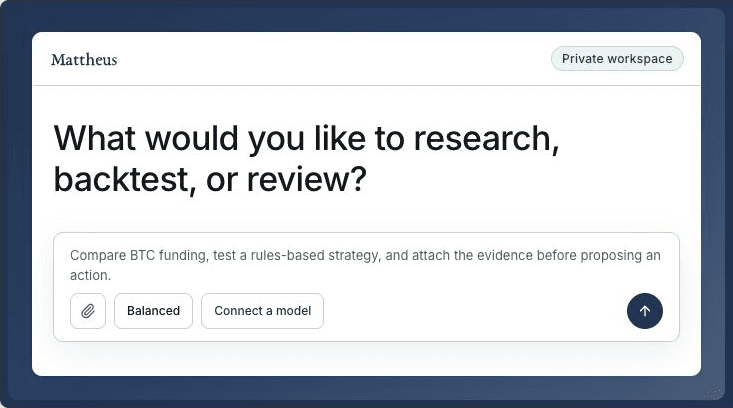
Mattheus is organized around this continuity. The next run begins with the previous strategy history available: its goals, research, tests, positions, outcomes, and unresolved decisions. That turns each run into the next step of an inspectable process instead of another beginning from zero.
More blogs to read



Private Beta · Whitelist Required