Current Blog
From Intelligence to Liquidity
Trading intelligence matters only when an agent can reach fragmented markets without rebuilding execution venue by venue.

A trading agent can form a useful view of a market and still stop short of execution. Intelligence may identify an opportunity, define a rule, and establish limits, but markets are fragmented across brokers, exchanges, protocols, and other venues. Reaching them is a separate systems problem.
Intelligence stops before execution
Research produces a thesis. Testing shows how that thesis behaves under selected assumptions. Monitoring indicates when the conditions may be present. None of those steps, by themselves, determine how an order should reach a market. Execution requires venue-specific connections, instrument mappings, order conventions, authentication, and response handling.
Without a routing layer, each new destination becomes another bespoke integration. The strategy may be portable in theory while the execution workflow remains tied to a single broker or protocol. That makes it harder to compare venues, adapt to new market structure, or return consistent results to the agent’s strategy context.
Why liquidity is fragmented
Liquidity does not live in one uniform pool. Access depends on the market and the route used to enter it. Even when two venues expose the same instrument, their operating conditions can differ in ways the workflow must understand.
Brokers expose different account models, permissions, and order interfaces.
Exchanges use their own symbols, market data, order types, and session rules.
Protocols introduce network, wallet, settlement, and contract considerations.
Other venues may impose distinct size, timing, price, or access conditions.
These differences do not make a strategy invalid, but they do mean that execution cannot be treated as a generic final button. The workflow needs a normalized way to express intent while retaining the details required by the selected destination.
An idea is not an executed strategy until it can reach the market.
What a routing layer changes
A routing layer separates strategy intent from venue-specific transport. The agent can express the action it is considering—instrument, side, size, order constraints, and timing—through a consistent interface. The routing layer then translates that intent for an available broker, exchange, protocol, or venue.
That boundary reduces repeated integration work. A strategy does not need to embed every venue’s connection logic, and a new connection does not require the research workflow to be rewritten. The execution path can change while the strategy’s goal, evidence, and decision record remain intact.
Normalization does not mean erasing venue differences. The routing layer still needs to preserve the details that affect an order, including available order types, minimum sizes, trading sessions, settlement behavior, and response semantics. A consistent strategy interface is useful only when the translation remains faithful to the destination. The agent should be able to express a common intent while the resulting record shows how that intent was represented on the selected venue.
This boundary also makes venue changes easier to review. The strategy can remain stable while the user compares a different route, provided the resulting order details and outcomes are written back clearly.
Execution within user-defined limits
Routing should not expand authority. The user’s permissions and risk limits remain part of the workflow before an action reaches a destination. Instrument access, position size, order type, price tolerance, approval requirements, and other constraints can be evaluated against the proposed action.
This distinction matters because connectivity and permission are different capabilities. A system may be able to reach a venue without being authorized to place every possible order there. Keeping the two separate allows broader market access while maintaining narrow, inspectable authority.
Returning fills and outcomes to context
The execution loop is incomplete until the response returns to the strategy. Fills, partial fills, rejections, cancellations, fees, timing, and venue details all affect what the agent should understand next. A position should be attached to the order that created it, and the order should remain attached to the thesis and limits that approved it.
That feedback turns routing into more than transport. It supplies evidence for monitoring, evaluation, and the next test. If execution diverges from an assumption, the strategy can record the difference instead of treating the modeled result as reality.
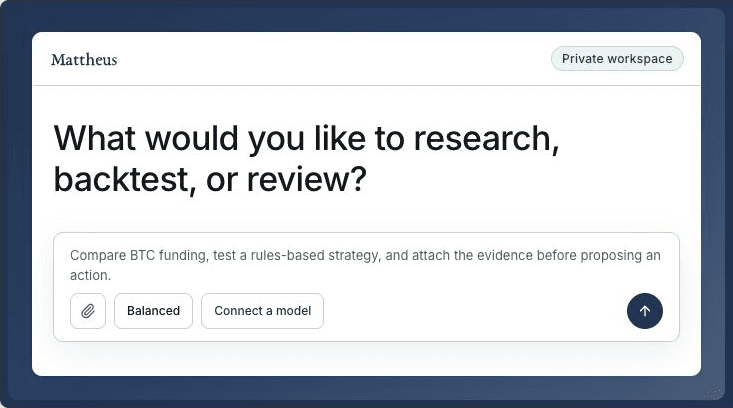
Mattheus treats the path from intelligence to liquidity as one continuous workflow: research and tests define intent, user limits scope the action, routing reaches the selected market, and fills or failures return to the same context. The goal is continuity without rebuilding execution venue by venue.
More blogs to read



Private Beta · Whitelist Required